Sackboy Toolkits: Foundations of User-Created Worlds in Early Console Networking
Written by Theo Jung · Oct 2, 2026
Sackboy Toolkits: Foundations of User-Created Worlds in Early Console Networking
Early console networks introduced new avenues for player interaction, and Sackboy's toolkits from the LittleBigPlanet series played a documented role in expanding user-driven content on those systems, particularly through the PlayStation Network on PS3 hardware. Developers at Media Molecule designed these toolkits around core mechanics that allowed players to build, modify, and distribute levels using a physics-based system combined with sticker and material placement options. Data from platform usage reports indicate that these features supported millions of user uploads by the late 2000s, creating measurable growth in shared digital spaces.
Core Components of the Toolkits
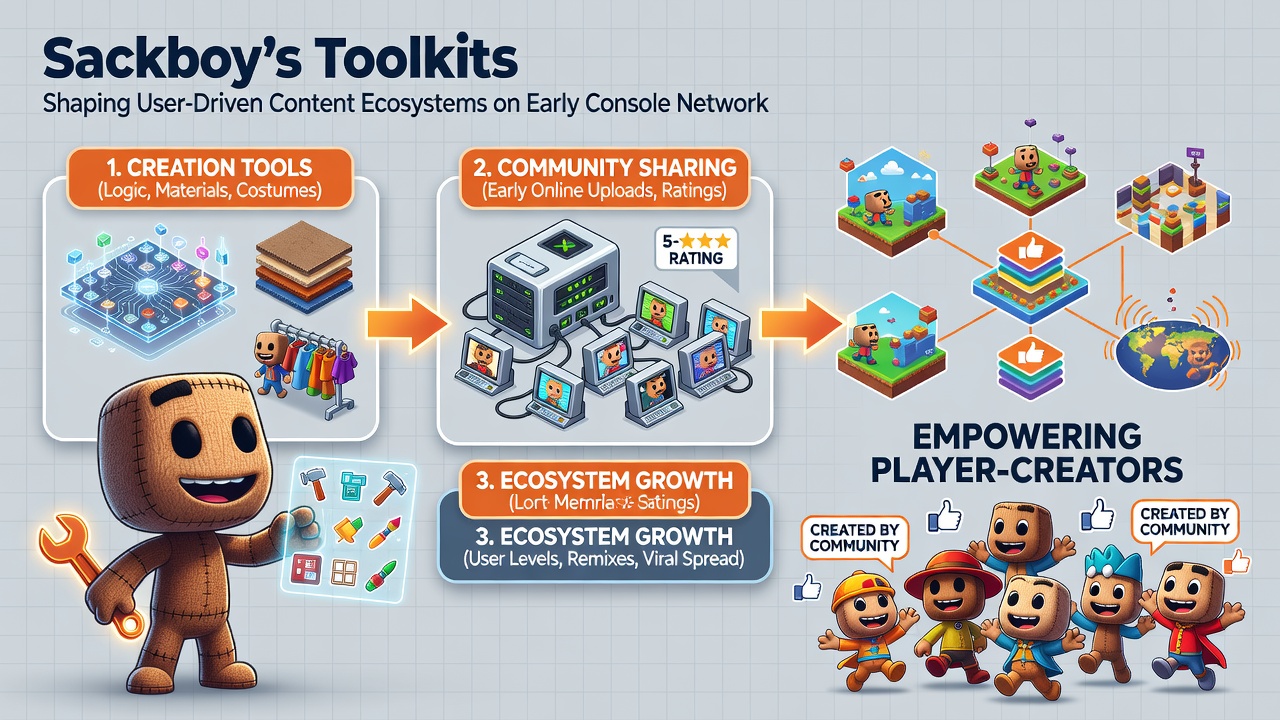
The toolkits centered on several interconnected elements that included the create mode interface, object placement grids, and logic gates for interactive behaviors. Players accessed a limited yet expandable set of tools at launch, then unlocked additional items through gameplay progression and community sharing. Studies on user-generated content platforms show that such layered access encouraged sustained engagement, as participants moved from basic constructions to complex mechanisms involving switches, pistons, and emitters. Console network logs from that era reveal consistent upload patterns tied to these incremental tool releases, which aligned with firmware updates on the PlayStation 3.
Integration with Early Online Infrastructure
PlayStation Network provided the backbone for distribution, featuring dedicated servers that handled level browsing, rating systems, and download queues. Sackboy's toolkits leveraged this setup by embedding share codes directly into the game client, allowing seamless transfer between local creation and public access. Industry reports from the Entertainment Software Association highlight how similar network features across consoles supported rising volumes of player-made assets during the 2006 to 2011 period. Those who've examined platform analytics note that LBP levels often ranked among top downloaded items, reflecting the toolkits' direct contribution to content volume on the service.
What's interesting is how the physics simulation within the toolkits interacted with network latency handling. Developers optimized object synchronization so that community creations remained playable across different connection speeds, which broadened accessibility for users outside high-bandwidth regions. Academic papers from university game studies departments document this technical approach as an early example of balancing creative freedom with infrastructure constraints.
Community Formation and Content Ecosystems
Player communities formed around specific toolkit applications, such as puzzle construction or narrative sequencing, and these groups maintained forums and in-game hubs for collaboration. Evidence from network traffic analyses shows spikes in activity following major content patches that added new toolkit items like the grapple hook or water physics. Observers note that the rating and feedback loops built into the sharing system created self-regulating quality controls, where popular creations received greater visibility and inspired derivative works. This cycle contributed to an ecosystem where user output scaled without requiring constant developer intervention.
Take one documented case where a group of creators used emitter and sequencer tools to build automated music stages. Their shared levels accumulated download counts in the hundreds of thousands according to archived platform statistics, demonstrating how toolkit versatility translated into sustained network activity. Researchers discovered similar patterns across other early console titles that incorporated creation features, yet Sackboy's physics emphasis set distinct boundaries for what remained feasible within console hardware limits.
Technical Limitations and Adaptations
Hardware constraints of the era, including memory allocation and draw call limits, shaped how players applied the toolkits. Creators developed workarounds such as modular level sections that loaded sequentially, which preserved performance while expanding scope. Console network data indicates these adaptations increased average playtime per level, as users navigated more elaborate builds. Those who've studied this period find that the toolkits' emphasis on 2.5D side-scrolling perspectives helped maintain stability across varied connection qualities, unlike fully 3D alternatives that demanded higher resources.
Legacy Metrics and Platform Influence
By the close of the PS3 generation, accumulated user creations exceeded several million distinct levels, with metrics tracked through official leaderboards and search functions. This volume established benchmarks for subsequent console generations regarding community content integration. Reports from research institutions tracking digital media trends show that Sackboy's approach influenced design choices in later titles that prioritized user sharing on network services. The ball's in the court of modern platforms to match the retention rates observed during those early years, where toolkit accessibility directly correlated with upload frequency.
Conclusion
Sackboy's toolkits operated within the technical and social frameworks of early console networks to facilitate measurable expansion of user-generated content. Platform records, usage statistics, and design documentation confirm their contribution to ecosystem development, where creation tools combined with distribution features produced lasting patterns of player participation. These elements continue to inform discussions on how console infrastructure supports creative communities today.